
JIC vs ORFS Fittings: Seals, Threads and Torque
JIC seals on a 37° metal cone; ORFS seals on an O-ring against a flat face. Here are the thread sizes, the two sizes that thread together, and how to tighten each.
Last updated October 30, 2026. Reference values; verify against manufacturer specifications.
JIC and ORFS fittings are both used on hydraulic hoses and tubes, often on the same machine. They look similar from a distance: a male fitting with external threads and a female swivel nut. But they seal in different ways and use different threads. This page explains the differences, gives the ORFS sizes next to JIC, and covers the two sizes where the threads match by accident.
The short answer
- JIC seals metal-to-metal on a 37° cone. ORFS (O-ring face seal) seals with an O-ring pressed between two flat faces.
- ORFS threads are not the same as JIC threads for the same dash size. A -8 JIC is 3/4-16; a -8 ORFS is 13/16-16.
- They do not connect to each other. Two sizes share threads with a different JIC dash size, which can be misleading: -4 ORFS has the -6 JIC thread, and -12 ORFS has the -14 JIC thread.
How each fitting seals
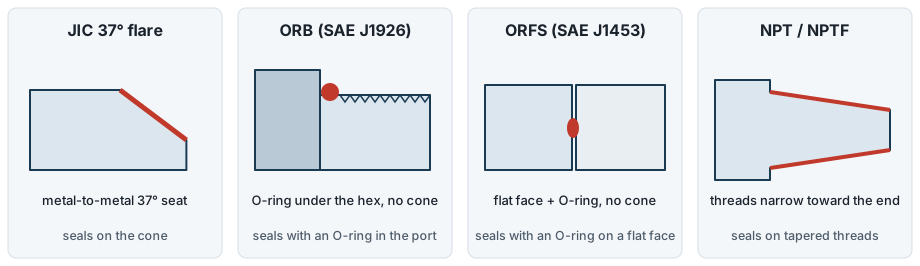
The JIC seal depends on two hard 37° surfaces being pressed together. That makes it simple and reusable, and its temperature range is not limited by a seal material. But it is sensitive to scratches on the cone and to over-tightening. The ORFS seal depends on an O-ring sitting in a groove in the male face. When the nut is tightened, the female's flat face squeezes the O-ring until the metal faces touch. Because the elastomer does the sealing, ORFS is often chosen for high-pressure and high-vibration systems where a leak-free joint is the priority.
JIC vs ORFS at a glance
| Feature | JIC 37° flare | ORFS (O-ring face seal) |
|---|---|---|
| Standard | SAE J514, ISO 8434-2 | SAE J1453, ISO 8434-3 |
| Seal | Metal-to-metal on a 37° cone | Elastomer O-ring in a groove on a flat face |
| Male end | 37° cone nose | Flat face with an O-ring groove |
| Female end | Swivel nut with 37° seat | Swivel nut with a flat face |
| Threads | UNF / UN, e.g. -6 = 9/16-18 | Different UN/UNF series, e.g. -6 = 11/16-16 |
| Reassembly | Seat can be reused if undamaged | Replace the O-ring each time |
| Tightening | More flats (1–2) after resistance | Fewer flats (1/3–3/4) after resistance |
| Temperature limit | Set by the metal parts | Also limited by the O-ring material |
ORFS sizes compared with JIC
Dash sizes still describe the tube OD in sixteenths of an inch, so a -8 is for 1/2 in tube in both systems. The threads are different:
| Dash | Tube OD (in) | ORFS thread | ORFS male OD (in / mm) | ORFS female ID (in, approx.) | JIC thread, same dash |
|---|---|---|---|---|---|
| -4 | 1/4 | 9/16-18 | 0.56 / 14.29 | 0.51 | 7/16-20 |
| -6 | 3/8 | 11/16-16 | 0.69 / 17.46 | 0.63 | 9/16-18 |
| -8 | 1/2 | 13/16-16 | 0.82 / 20.64 | 0.75 | 3/4-16 |
| -10 | 5/8 | 1-14 | 1.00 / 25.40 | 0.93 | 7/8-14 |
| -12 | 3/4 | 1-3/16-12 | 1.19 / 30.16 | 1.11 | 1-1/16-12 |
| -16 | 1 | 1-7/16-12 | 1.44 / 36.51 | 1.36 | 1-5/16-12 |
| -20 | 1-1/4 | 1-11/16-12 | 1.69 / 42.86 | 1.61 | 1-5/8-12 |
| -24 | 1-1/2 | 2-12 | 2.00 / 50.80 | 1.92 | 1-7/8-12 |
ORFS threads and approximate measurements as listed in the Eaton and McGill thread identification guides and Parker Seal-Lok data, which agree. JIC per SAE J514.
The two sizes that thread together
| ORFS size | Thread | JIC size with the same thread | Result if mixed |
|---|---|---|---|
| -4 ORFS | 9/16-18 | -6 JIC | Threads engage fully, but a cone cannot seal on a flat O-ring face |
| -12 ORFS | 1-3/16-12 | -14 JIC | Same problem: the parts screw together but do not seal |
If a -6 JIC male threads smoothly into what you thought was a -6 hose end, but the hose end has a flat face inside, it is a -4 ORFS female. The joint will tighten and may even hold briefly at low pressure, but there is no proper seal. Always look at the sealing surface before you assemble.
How to tell JIC from ORFS
- Look at the male end. JIC has a pointed 37° cone. ORFS has a flat face with a groove, usually holding a visible O-ring.
- Look inside the female nut. JIC has a conical seat. ORFS has a flat face.
- Measure the thread. Compare the OD and TPI with the table above and the JIC size chart. A 0.69 in, 16 TPI male, for example, matches -6 ORFS, not any JIC size.
- Use the finder on the JIC identification page to check one measurement against both families at once.
Tightening: ORFS vs JIC
The two systems take very different rotation after wrench resistance. JIC typically needs 1 to 2 flats. ORFS needs 1/3 to 3/4 of a flat, because the metal faces meet soon after the O-ring is compressed. Parker's reference torque values are close to JIC in the middle sizes but differ at the small and large ends:
| Dash | ORFS torque (N·m / ft-lb) | ORFS FFWR (flats) | JIC swivel torque (N·m / ft-lb) | JIC FFWR (flats) |
|---|---|---|---|---|
| -4 | 25 / 18 | 1/2–3/4 | 18 / 13 | 2 |
| -6 | 40 / 30 | 1/2–3/4 | 30 / 22 | 1-1/2 |
| -8 | 55 / 40 | 1/2–3/4 | 57 / 42 | 1-1/2 |
| -10 | 80 / 60 | 1/2–3/4 | 81 / 60 | 1-1/2 |
| -12 | 115 / 85 | 1/3–1/2 | 114 / 84 | 1-1/4 |
| -16 | 150 / 110 | 1/3–1/2 | 160 / 118 | 1 |
| -20 | 205 / 150 | 1/3–1/2 | 228 / 168 | 1 |
| -24 | 315 / 230 | 1/3–1/2 | 265 / 195 | 1 |
Parker Seal-Lok ORFS values and Parker Catalog 4400 JIC swivel values. Values apply to Parker steel components. Use your fitting maker's instructions. More JIC detail is on the JIC torque chart.
Connecting JIC and ORFS
To join the two systems, use an adapter: male ORFS on one side, male JIC on the other, for example. Replace the ORFS O-ring whenever the joint is taken apart. Keep the JIC cone free of grease and debris. ORFS fittings also share a machine with O-ring boss (ORB) ports. The JIC vs ORB guide explains that third sealing style.
References
Eaton Thread Identification Guide; McGill Hose thread identification guide; Parker Seal-Lok ORFS assembly data; Parker Catalog 4400 JIC assembly methods; SAE J514 and SAE J1453 dimensions as published by these manufacturers. Values are reference only.
Frequently asked questions
Can you connect JIC to ORFS?
Not directly. The seals are different (37° cone vs flat face with O-ring) and the threads differ for the same dash size. Use a JIC-to-ORFS adapter.
Is a -6 ORFS the same thread as a -6 JIC?
No. A -6 ORFS is 11/16-16, while a -6 JIC is 9/16-18. The 9/16-18 thread is used on -4 ORFS.
Why does my JIC fitting thread into an ORFS fitting?
In two cases the threads match: -4 ORFS uses the -6 JIC thread (9/16-18), and -12 ORFS uses the -14 JIC thread (1-3/16-12). The parts screw together but do not seal.
Is ORFS better than JIC?
Each has strengths. ORFS uses an O-ring and is often chosen for high-pressure, high-vibration systems. JIC has no elastomer seal to limit its temperature range and can be reassembled without a new seal.
Do I need to replace the O-ring on an ORFS fitting?
Yes. Manufacturers recommend a new O-ring whenever an ORFS joint is disassembled.