
JIC vs NPT Fittings: How to Tell Them Apart
JIC seals on a 37° flare with straight threads; NPT seals on tapered threads. Here are the measurements, the look-alike sizes and four quick checks.
Last updated October 30, 2026. Reference values; verify against manufacturer specifications.
JIC and NPT are both inch fittings with 60° threads, and some sizes measure almost the same with calipers. They seal in completely different ways, though. JIC seals on a 37° flare with straight threads. NPT seals on the threads themselves, which taper. This page shows how to tell them apart and which sizes are easy to mix up.
The short answer
- JIC: straight threads, with a 37° cone (male) or seat (female) that does the sealing. No tape or sealant.
- NPT: tapered threads that wedge together. The seal is on the threads, with thread sealant or PTFE tape.
- Don't mix them: a JIC fitting will not seal in an NPT port, or the other way round. Use a JIC-to-NPT adapter.
How each one seals
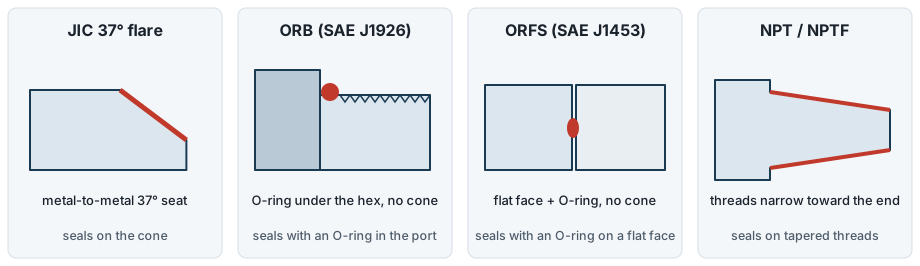
On a JIC joint, the nut pulls the male cone into the female seat, and the two 37° surfaces form the seal. The threads only hold the parts together. On an NPT joint, the male thread gets wider along its length and the female gets narrower. Tightening forces the threads into each other, and a sealant fills the small spiral gaps that are left.
NPTF (Dryseal) is a variant with controlled crests and roots. It is designed to seal by thread contact even without sealant. Both NPT and NPTF use the same sizes and TPI. The Eaton and McGill identification guides both note that the NFPA does not recommend NPTF for hydraulic connections. Tapered threads also wedge deeper each time they are re-tightened, which makes them harder to reseal after disassembly.
JIC vs NPT at a glance
| Feature | JIC 37° flare | NPT / NPTF |
|---|---|---|
| Thread | Straight (parallel) UNF / UN | Tapered pipe thread |
| Thread angle | 60° | 60° |
| Where it seals | 37° metal cone and seat | On the threads (NPT with sealant; NPTF by thread interference) |
| Sealant or tape | Never | Required for NPT; usually still used on NPTF |
| Size name refers to | Tube OD in 1/16 in (dash) | Nominal pipe size, not a measured diameter |
| Reusable | Yes, if seats are undamaged | Limited; harder to reseal after disassembly |
| Hydraulic use | Common for hose and tube connections | Found on older equipment; not recommended by the NFPA for hydraulics |
NPT sizes and measurements
NPT sizes are nominal pipe sizes. They do not match any diameter you can measure. A rule of thumb in thread identification guides: the measured OD of a male NPT thread is roughly 1/4 in larger than the nominal size in the common small sizes. A 1/4 NPT male, for example, measures about 0.54 in.
| Nominal size | Thread | TPI | Male OD (in, approx.) | Male OD (mm, approx.) | Female ID (in, approx.) | Female ID (mm, approx.) |
|---|---|---|---|---|---|---|
| 1/8 | 1/8-27 | 27 | 0.41 | 10.4 | 0.38 | 9.7 |
| 1/4 | 1/4-18 | 18 | 0.54 | 13.7 | 0.49 | 12.4 |
| 3/8 | 3/8-18 | 18 | 0.68 | 17.3 | 0.63 | 16.0 |
| 1/2 | 1/2-14 | 14 | 0.84 | 21.3 | 0.77 | 19.6 |
| 3/4 | 3/4-14 | 14 | 1.05 | 26.7 | 0.98 | 24.9 |
| 1 | 1-11½ | 11-1/2 | 1.32 | 33.5 | 1.24 | 31.5 |
Approximate measured values as published in the Eaton and McGill thread identification guides. They agree for all sizes shown. Because the thread tapers, the reading depends on where you measure: take it at the larger end of the male thread, about two or three threads from the end.
Sizes that are easy to confuse
NPT and JIC both use a 60° thread form and some of the same TPI, so a thread gauge alone will sometimes "fit" both. These pairs cause the most trouble:
| NPT size | NPT OD / TPI | Closest JIC | JIC OD / TPI | How to tell |
|---|---|---|---|---|
| 1/4 NPT | 0.54 in / 18 | -6 (9/16-18) | 0.5625 in / 18 | Same TPI. NPT tapers and has no 37° cone |
| 1/2 NPT | 0.84 in / 14 | -10 (7/8-14) | 0.875 in / 14 | Same TPI. NPT tapers; JIC OD is constant along the thread |
| 1 NPT | 1.32 in / 11-1/2 | -16 (1-5/16-12) | 1.3125 in / 12 | Pitch is close. Count over a full inch and check for a taper |
| 3/8 NPT | 0.68 in / 18 | -8 (3/4-16) | 0.75 in / 16 | Different TPI and diameter |
| 3/4 NPT | 1.05 in / 14 | -12 (1-1/16-12) | 1.0625 in / 12 | Different TPI |
The -6 JIC vs 1/4 NPT pair is the most common mix-up. Both have 18 threads per inch and measure within about 0.6 mm. The quickest check is the end of the fitting. A JIC male has a smooth 37° cone in front of the threads. An NPT male has threads that run almost to the end and get visibly smaller.
How to tell JIC from NPT in four checks
- Look at the end. A smooth cone in front of the male threads means a flare fitting, such as JIC. Threads that run to the tip with no cone point to a pipe thread.
- Look along the threads. Lay a straight edge along the male crests. A tapered thread shows a gap at one end; a JIC thread lies flat.
- Measure at both ends. On a male NPT, the caliper reading near the tip is smaller than near the hex. On JIC it is the same.
- Check for sealant. Old tape or paste on the threads strongly suggests NPT. JIC joints should never have it.
For caliper technique and thread gauges, see how to measure JIC fittings. To check a measurement against several thread families at once, use the finder on the JIC identification page.
Connecting JIC to NPT
Where a hose with a JIC end has to go into an NPT port, the usual part is a male JIC × male NPT adapter. The NPT end goes into the port with sealant. The JIC end takes the hose swivel, dry. Common pairings include -4 JIC × 1/4 NPT, -6 JIC × 3/8 NPT and -8 JIC × 1/2 NPT, and many other combinations are made. Choose the NPT size to match the port and the JIC size to match the hose.
Keep sealant off the 37° cone. If tape or paste reaches the flare, it can stop the seat sealing and contaminate the hydraulic oil.
Other look-alikes
A tapered thread can also be BSPT (British, 55° thread form) rather than NPT. The JIC vs BSP page covers that case. If the thread is straight and there is an O-ring near the hex, the fitting is probably an O-ring boss part. See JIC vs ORB.
References
Eaton Thread Identification Guide (NPTF dimensions and NFPA note); McGill Hose thread identification guide; JIC dimensions from SAE J514 as published in Parker and Eaton catalogs. Values are reference only.
Frequently asked questions
Is JIC the same as NPT?
No. JIC uses straight threads and seals on a 37° flare. NPT uses tapered threads that seal on the threads with sealant. They do not seal if mixed.
Will a -6 JIC fit a 1/4 NPT?
It may start, because both have 18 threads per inch and similar diameters (0.5625 in vs about 0.54 in), but it will not seal. The NPT taper and the missing 37° seat mean it will leak or damage the threads.
Do JIC fittings need Teflon tape like NPT?
No. Never put tape or sealant on a JIC thread. Only the NPT end of an adapter needs sealant.
How do I measure an NPT thread?
Measure the male OD near the large end of the thread and count threads per inch. In the common small sizes the measured OD is roughly 1/4 in larger than the nominal size, so a 1/4 NPT measures about 0.54 in.
What is the difference between NPT and NPTF?
They share sizes and TPI. NPTF (Dryseal) has controlled crests and roots designed to seal by thread contact, while NPT relies on sealant. Neither is recommended by the NFPA for hydraulic systems.