
Male vs Female JIC Fittings
The male JIC end has outside threads and a 37° cone; the female has inside threads and a matching seat. Here is how they seal, and how to measure each.
Last updated October 30, 2026. Reference values; verify against manufacturer specifications.
Every JIC connection has two halves: a male end with external threads and a 37° cone nose, and a female end with internal threads and a matching 37° seat. Knowing which is which matters when you order parts, read a catalog or measure a fitting. The two halves are measured differently, and the numbers are not the same for the same dash size. This page explains both halves, shows how they seal, and gives male and female measurements side by side.
The short answer
- Male JIC: threads on the outside, cone nose on the end. Measure the outside diameter (OD).
- Female JIC: threads on the inside, usually a swivel nut. Measure the inside diameter (ID).
- For the same dash size, the female ID reads smaller than the male OD, by about 1 mm on small sizes and 2 mm on large ones. Use the right column of the size chart.
- The seal is between the male cone and the female seat. The threads only hold the parts together.
How a male and female JIC fitting seal
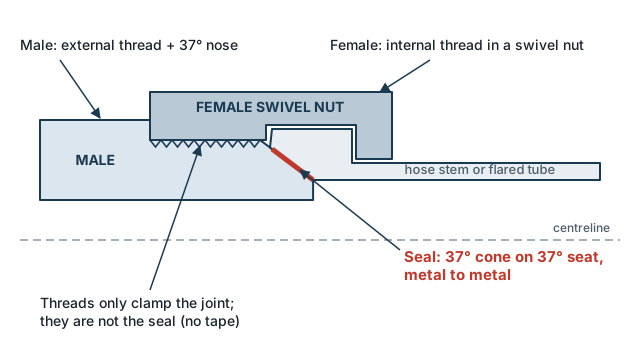
When the swivel nut is tightened, it pulls the female seat against the male cone. The two 37° surfaces meet metal-to-metal, and that contact is the seal. This is why a scratched cone leaks even when the threads are perfect, and why thread tape or sealant should never be used on JIC threads. Sealant on the threads does nothing for the cone seal and can contaminate the system.
On a flared tube joint, the female side is a tube nut and sleeve. The tube end is flared to 37°, and the nut presses the flare against the male cone. The seal is the same metal-to-metal contact.
Male vs female at a glance
| Feature | Male JIC | Female JIC |
|---|---|---|
| Thread | External (on the outside) | Internal (inside the nut) |
| Sealing surface | Convex 37° cone nose at the end | Concave 37° seat inside the nut, or a flared tube held by a tube nut |
| What to measure | Thread OD across the crests | Thread ID across the inner crests |
| Does it turn? | Usually fixed: part of an adapter, tee or port end | Usually a swivel nut that turns freely |
| Typical parts | Adapters, tees, elbows, bulkhead unions, valve ends | Hose-end swivels, tube nuts, swivel adapters |
| Seat angle check | Gauge on the outside of the cone | Gauge inside the nut, against the seat |
Male OD vs female ID by dash size
The male OD is the nominal thread size. The female ID is smaller, because you are measuring the inner crests of the internal thread. Female values are approximate and vary slightly between manufacturers.
| Dash | Thread | Male OD (in) | Male OD (mm) | Female ID (in, approx.) | Female ID (mm, approx.) | Male OD − female ID (mm) |
|---|---|---|---|---|---|---|
| -2 | 5/16-24 | 0.313 | 7.94 | 0.27 | 6.9 | 1.1 |
| -3 | 3/8-24 | 0.375 | 9.53 | 0.34 | 8.6 | 0.9 |
| -4 | 7/16-20 | 0.438 | 11.11 | 0.39 | 9.9 | 1.2 |
| -5 | 1/2-20 | 0.500 | 12.70 | 0.45 | 11.4 | 1.3 |
| -6 | 9/16-18 | 0.563 | 14.29 | 0.51 | 13.0 | 1.3 |
| -8 | 3/4-16 | 0.750 | 19.05 | 0.69 | 17.5 | 1.5 |
| -10 | 7/8-14 | 0.875 | 22.23 | 0.81 | 20.6 | 1.7 |
| -12 | 1-1/16-12 | 1.063 | 26.99 | 0.98 | 24.9 | 2.1 |
| -14 | 1-3/16-12 | 1.188 | 30.16 | 1.10 | 27.9 | 2.2 |
| -16 | 1-5/16-12 | 1.313 | 33.34 | 1.23 | 31.2 | 2.1 |
| -20 | 1-5/8-12 | 1.625 | 41.28 | 1.54 | 39.1 | 2.2 |
| -24 | 1-7/8-12 | 1.875 | 47.63 | 1.79 | 45.5 | 2.2 |
| -32 | 2-1/2-12 | 2.500 | 63.50 | 2.42 | 61.5 | 2.0 |
Male OD per SAE J514 (nominal thread major diameter). Female ID: approximate values published in the Eaton and McGill thread identification guides. The difference column is calculated. Full table with tube sizes: JIC fitting size chart.
How to measure each one
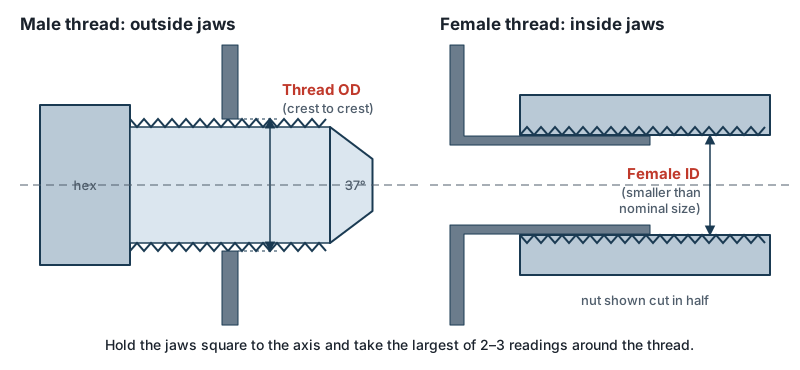
- Male: put the outside jaws of the calipers across the thread crests. Read at two or three points around the thread and use the largest steady value.
- Female: put the inside jaws into the nut and spread them across the inner thread crests. Do not measure the chamfer at the opening, which reads large.
- Pitch: the same thread gauge works on both. A male and female of the same JIC dash size have the same TPI.
The full method is in how to measure JIC fittings.
Typical joints
| Connection | Male side | Female side |
|---|---|---|
| Hose to adapter | Adapter or port fitting with a 37° nose | Hose-end swivel nut |
| Flared tube to adapter | Adapter with a 37° nose | Tube nut and sleeve pushing the flared tube onto the nose |
| Hose to hose | Male-to-male union | Both hose-end swivel nuts |
| Swivel adapter to port | Port-side thread (for example ORB or NPT) | Swivel nut on the JIC end |
Naming in catalogs
Catalogs describe JIC parts by gender, dash size and shape, for example "male JIC -8 × male ORB -8 straight" or "female JIC swivel -6 hose end". A "swivel" female turns freely on the fitting, so you can tighten it without twisting the hose. Each maker has its own part codes for the same ends, so check the drawing or the end description, not only the code.
Common mistakes
- Reading the female ID against the male column. A -6 female measures about 0.51 in, which is close to the -5 male OD of 0.50 in. Check that you are using the female column.
- Assuming the cone is always on the male. That holds for JIC, but Japanese JIS 30° fittings put a concave seat on the male. See JIC vs JIS.
- Using sealant on the threads. See common JIC fitting mistakes.
If you are not sure what a fitting is, the JIC identification guide has a finder for male and female measurements.
Male and female ends appear on hose ends and adapters in many shapes; see JIC hose end sizes and JIC fitting types.
References
SAE J514 dimensions as published by Parker and Eaton; Eaton Thread Identification Guide; McGill Hose thread identification guide. Values are reference only.
Frequently asked questions
Which side of a JIC fitting is male?
The male end has threads on the outside and a 37° cone nose on the end. The female end has threads inside a nut and a matching 37° seat.
Why does my female JIC measure smaller than the chart size?
A female thread is measured across its inner crests, which are smaller than the nominal thread size. For example, a -6 female (9/16-18) measures about 0.51 in, not 0.5625 in.
Do male and female JIC fittings of the same dash size always fit?
Yes, if both are JIC 37° of the same dash size. They share the same thread and seat angle.
Is a JIC swivel nut male or female?
Female. The swivel nut has internal threads and the 37° seat, and it turns so the hose does not twist when you tighten it.
Should I put thread sealant on JIC threads?
No. JIC seals on the 37° cone, not the threads. Sealant does not help the seal and can contaminate the hydraulic system.