
How to Measure JIC Fittings
Use calipers, a thread pitch gauge and a seat angle gauge to identify a JIC 37° fitting, and to rule out ORB, SAE 45°, metric and BSP look-alikes.
Last updated October 30, 2026. Reference values; verify against manufacturer specifications.
Identifying a JIC fitting takes three measurements: thread diameter, threads per inch (TPI), and seat angle. Each one rules out a group of look-alike fittings, and together they point to one row of the JIC fitting size chart. This guide walks through the tools, the method, and the readings that usually cause trouble.
Tools you need
- Calipers. Digital or dial calipers that read to at least 0.01 in (0.1 mm). Inside jaws are needed for female threads.
- Thread pitch gauge. An inch (TPI) gauge is essential. A metric pitch gauge is also useful, because ruling out metric threads is part of identifying JIC.
- Seat angle gauge. Often sold as a flare or seat gauge, with profiles for 37°, 45° and usually 24° and 30°.
- A clean rag and a soft brush. Dirt, paint and old sealant on the threads change the reading.
- A thread identification chart such as the one on this site.
Step 1: Clean the fitting and decide male or female
Wipe the threads and the seat. Then decide which half you are holding:
- Male: threads are on the outside. A JIC male has a cone-shaped nose ahead of the threads.
- Female: threads are inside a nut. A JIC female is usually a swivel nut on a hose end, with a 37° seat inside. See male vs female JIC fittings for how the two halves seal.
While you are looking, note anything that is clearly not JIC: an O-ring under the hex (O-ring boss), a flat face with an O-ring (O-ring face seal), or threads that narrow toward the end (a tapered pipe thread such as NPT).
Step 2: Measure the thread diameter
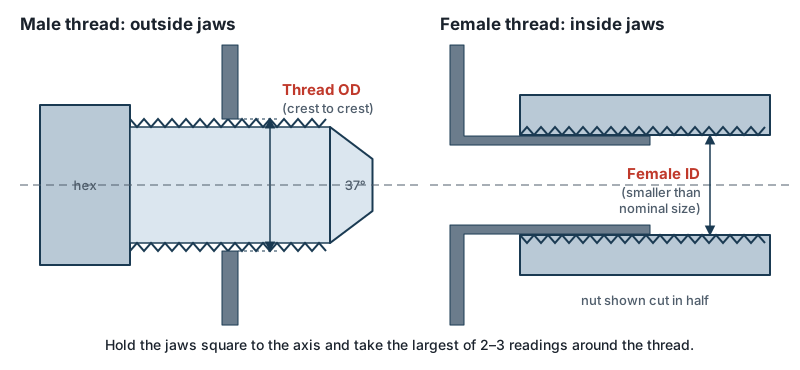
Male threads
Close the outside jaws of the calipers across the thread crests (the tops of the threads), square to the fitting's axis. Take readings at two or three points around the circumference and use the largest. This is the male thread OD.
Female threads
Use the inside jaws across the inner thread crests. This reading is the female thread ID. It will be noticeably smaller than the nominal thread size, because you are measuring across the inner crests rather than the full thread. The chart lists approximate female ID values for this reason.
What to expect from the reading
Real threads usually measure slightly under nominal, especially on used parts. A -6 male JIC fitting with a nominal 9/16 in (0.5625 in, 14.29 mm) thread will often read a few thousandths under that. Pick the chart row whose value is closest and slightly above your reading, then confirm with the next steps.
| Dash | Thread | Male OD, nominal (in / mm) | Female ID, approx. (in / mm) |
|---|---|---|---|
| -4 | 7/16-20 | 0.44 / 11.11 | 0.39 / 9.9 |
| -6 | 9/16-18 | 0.56 / 14.29 | 0.51 / 13.0 |
| -8 | 3/4-16 | 0.75 / 19.05 | 0.69 / 17.5 |
| -10 | 7/8-14 | 0.88 / 22.23 | 0.81 / 20.6 |
| -12 | 1-1/16-12 | 1.06 / 26.99 | 0.98 / 24.9 |
| -16 | 1-5/16-12 | 1.31 / 33.34 | 1.23 / 31.2 |
Step 3: Check the threads per inch
Try the leaves of the inch thread gauge against the threads, holding the gauge parallel to the fitting's axis. The correct leaf drops fully into the threads along its whole length with no light showing and no rocking. Check a second time a little further along the thread.
JIC threads use these pitches:
- 24 TPI: -2 and -3
- 20 TPI: -4 and -5
- 18 TPI: -6
- 16 TPI: -8
- 14 TPI: -10
- 12 TPI: -12 through -32
If an inch leaf seems close but not perfect, try the metric gauge. Some metric pitches are close to inch pitches over a short length: 18 TPI is 1.411 mm, very near a 1.5 mm metric pitch. Check over as many threads as the gauge covers. If a metric leaf fits better, the fitting is not JIC; see the JIC metric conversion guide for common metric and BSP look-alikes.
Step 4: Check the seat angle
The seat angle confirms the fitting family. JIC uses a 37° seat measured from the centerline.
- Choose the gauge profile for the angle you expect (37° first).
- On a male fitting, place the gauge against the cone-shaped nose. On a female fitting, place the matching end of the gauge into the nut against the internal seat.
- Line the gauge up with the fitting's centerline. The correct angle sits flush across the whole seat with no gap. The wrong one rocks on an edge or leaves a visible wedge of light.
- Try 45° as well. Because JIC and SAE 45° share threads in several sizes, the seat check is the only reliable way to separate them (see JIC vs SAE 45°).
Other readings point elsewhere: 24° suggests a metric DIN/ISO compression fitting, and 30° suggests a JIS or Komatsu-style fitting, or a BSP 60° cone (measured as a 30° half-angle) depending on the thread.
Step 5: Match all three to the chart
A fitting is JIC when the thread diameter, the TPI and the 37° seat all agree with a single row of the chart. For example:
- Male OD about 0.75 in, 16 TPI, 37° seat: -8 JIC (3/4-16, for 1/2 in tube).
- Male OD about 1.06 in, 12 TPI, 37° seat: -12 JIC (1-1/16-12, for 3/4 in tube).
- Male OD about 1.06 in, 14 TPI, 45° seat: -12 SAE 45° (1-1/16-14), not JIC.
- Male OD about 0.56 in, 18 TPI, flat end with an O-ring under the hex: -6 ORB, not JIC (see JIC vs ORB).
Measuring tube and hose
For a JIC tube connection, measure the tube OD with calipers. The dash size is that OD in sixteenths of an inch: 3/8 in tube is -6, 1/2 in tube is -8. For hose, the dash number printed on the layline normally refers to the hose inside diameter, not the end fitting. A -8 hose can have a -8 JIC end, but it can also carry an adapter or a different end size, so measure the end itself.
Common measuring errors
- Measuring the dash size instead of the thread. A "3/8 JIC" is usually a -6 fitting with a 9/16 in thread, not a 3/8 in thread.
- Measuring at an angle. Calipers held at an angle over-read. Keep the jaws square to the axis.
- Measuring a worn or damaged thread. Take readings in several places, and use the best-formed section.
- Trusting the thread alone. JIC, ORB, SAE 45° and AN can share threads. Always check the seat or seal type.
- Using a short gauge leaf. Close inch and metric pitches can look correct over two or three threads. Use the longest leaf contact possible.
References
Method and values are based on published thread identification guides, including the Eaton Thread Identification Guide and the McGill Hose thread identification guide, along with distributor measuring guides that describe seat-gauge use. Always confirm critical parts against the fitting manufacturer's specifications.
Frequently asked questions
How do I measure a JIC fitting size?
Measure the thread diameter with calipers, check the threads per inch with a thread gauge, and confirm the 37° seat with a seat angle gauge. Then find the row in a JIC size chart where all three match.
Why is my JIC thread measurement smaller than the chart?
Male threads usually measure slightly under nominal, especially when worn. Female threads are measured across the inner crests, so they read well under the nominal thread size. Use the closest chart value.
What does 3/8 JIC mean?
It usually means a -6 JIC fitting for 3/8 in tube, which has a 9/16-18 thread. Confirm by measuring, because some people use the thread size instead.
Do I need a seat gauge to identify a JIC fitting?
Yes, if the thread matches more than one fitting type. JIC and SAE 45° flare share threads in several sizes, and only the seat angle separates them.
Is the hose dash size the same as the fitting size?
Not always. The hose dash number usually describes hose inside diameter. The end fitting can be the same dash size or different, so measure the end.